
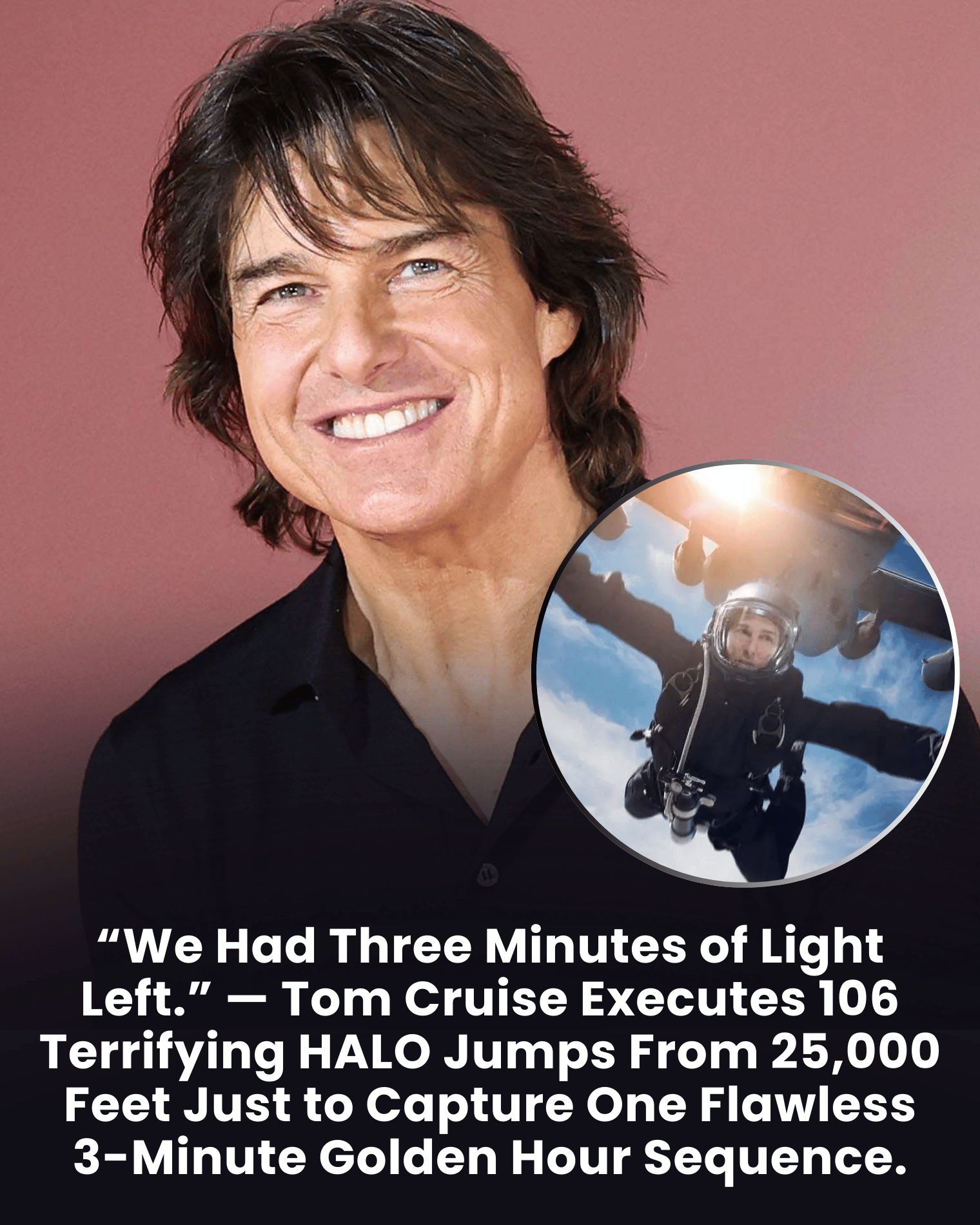
In modern action cinema, few actors are as closely associated with real stunts as Tom Cruise. While many Hollywood productions rely heavily on stunt doubles and computer-generated effects, Cruise has built a reputation for pushing physical limits in pursuit of realism. One of the most astonishing examples of that commitment came during the production of Mission: Impossible – Fallout, when the actor performed a stunt so complex it required more than a hundred attempts just to capture a few seconds of usable footage.
The sequence involved a military technique known as a High Altitude, Low Opening jump—commonly called a HALO jump. These parachute jumps are typically performed by elite special forces units rather than actors. The technique requires jumping from extremely high altitudes, often around 25,000 feet, while delaying the parachute deployment until close to the ground. At that height, the air is dangerously thin, which means jumpers must wear specialized oxygen helmets to avoid hypoxia, a potentially fatal lack of oxygen.
For Cruise, however, simply performing the jump once was not enough. The scene demanded precise choreography between the actor and a camera operator who was also free-falling beside him. Every movement in the air had to align perfectly with the story's visual requirements. The pair had to maintain their positions while falling at speeds approaching 165 miles per hour, all while capturing a cinematic shot that looked effortless on screen.
The difficulty increased dramatically because of the lighting conditions required for the scene. Director Christopher McQuarrie wanted the sequence filmed during "golden hour," the brief period just after sunset when the sky glows with warm, dramatic light. That window lasts only a few minutes each day. Once the sun dipped below the horizon, the opportunity for filming was gone until the next evening.
This meant the entire production team had only about three minutes of perfect lighting during each attempt. If the jump was slightly mistimed or the camera alignment wasn't perfect, the shot had to wait until the following day. Because of those limitations, Cruise ultimately performed the HALO jump 106 times during the filming process.
Each jump began inside a massive Boeing C‑17 Globemaster III, which carried the crew high above the filming location. As the aircraft doors opened, Cruise and the camera operator would leap into the open sky, oxygen masks secured and cameras rolling. In those brief seconds of free fall, they had to hit precise spatial marks while adjusting their bodies in mid-air to keep the shot framed perfectly.
The result on screen lasts only a few minutes, yet it represents weeks of preparation, training, and nerve-racking execution. Cruise trained extensively with professional skydivers to master the military technique safely. The dedication required to repeat such a dangerous stunt more than one hundred times demonstrated his determination to achieve authentic visuals rather than relying on digital shortcuts.
For audiences watching the finished film, the HALO jump sequence feels thrillingly real—and that's exactly the point. By performing the stunt himself under extreme conditions, Cruise delivered one of the most visually striking moments in the franchise. The brief three-minute scene stands as a powerful reminder of how far he is willing to go to create action that feels genuine, immersive, and unforgettable on the big screen.